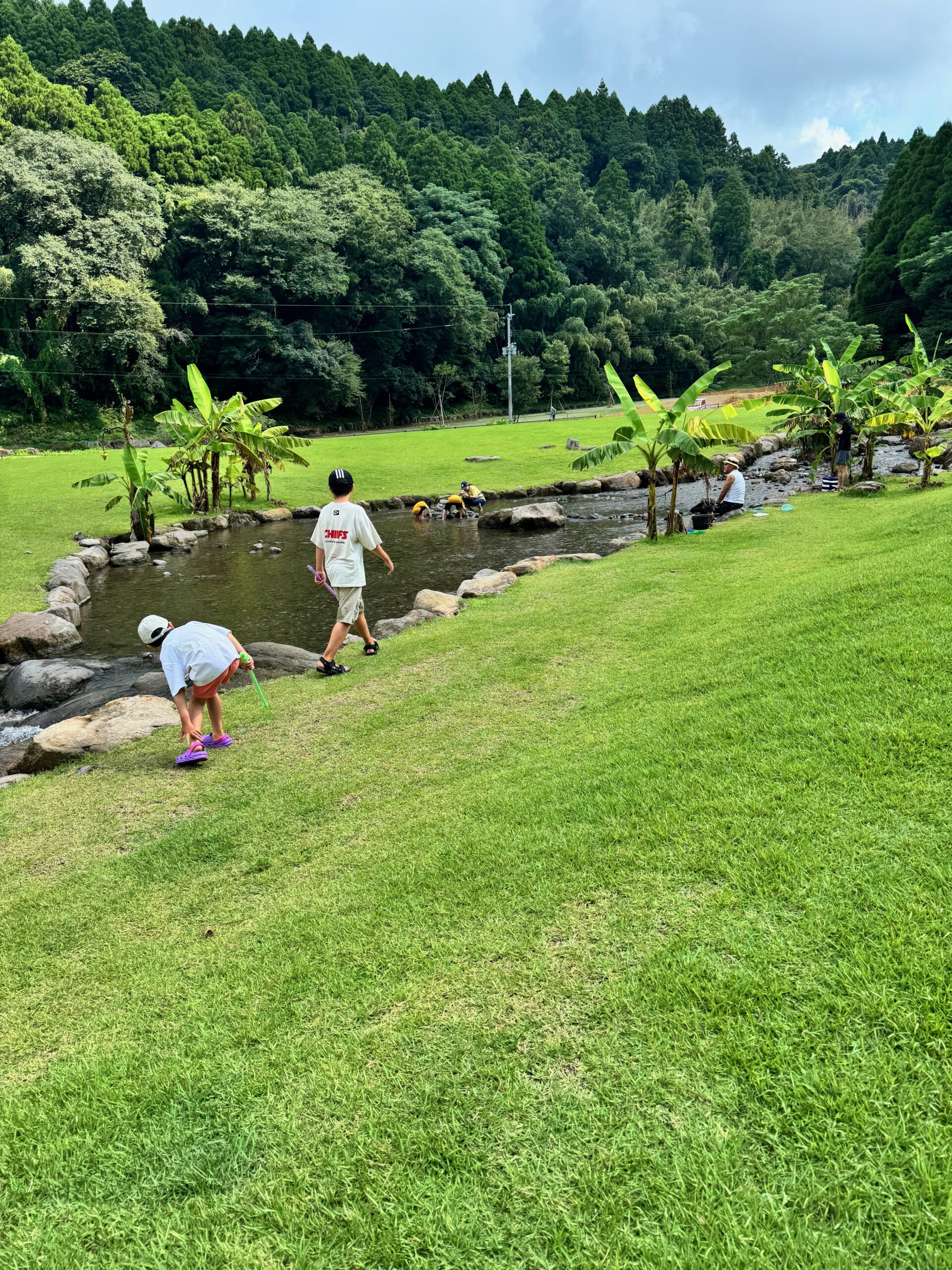
A Summer Trip to Kumamoto — Nature, Fish, and Family 🌿
Kumamoto Prefecture is a special place for our family. My mother’s grandmother and relatives live there, and we try to visit every two years or so. Last summer, my husband couldn’t make it due to work, so I took our two sons on a plane from Nagoya — just the three of us.
Our grandma and relatives were all doing well, and we shared a big meal together. It was the highlight of the trip.
Getting There: Flying from Nagoya
Kumamoto is in Kyushu — the southernmost of Japan’s four main islands. From Nagoya, the most convenient way is to fly from Chubu Centrair International Airport (中部国際空港) to Kumamoto Airport. It’s about an hour in the air, which for my boys is approximately the perfect length of a flight — long enough to feel like a real trip, short enough that nobody gets bored and difficult.
Traveling with two kids solo was an adventure in logistics. But there’s something special about being just the three of us — the boys were more cooperative than usual, and I felt this mix of pride and exhaustion that I think a lot of moms traveling alone with kids will recognize.
Kumamoto Castle
You can’t visit Kumamoto without seeing Kumamoto Castle (熊本城). It’s one of Japan’s most famous castles — a massive, imposing black structure with sweeping curved rooflines that looks like something from a history textbook.
The castle was severely damaged in the 2016 Kumamoto earthquakes and has been undergoing major reconstruction. When we visited, parts of the castle were still being restored — you could see the scaffolding alongside the restored sections. There was something moving about seeing this ancient structure being carefully rebuilt stone by stone. Kumamoto people are deeply proud of their castle, and the restoration project is a real point of community spirit.
The Fish Was Outstanding
Kumamoto is famous for its fresh seafood — particularly horse mackerel (aji) and various shellfish from the Ariake Sea (有明海). We went to a local seafood restaurant recommended by our relatives, and the sashimi was genuinely some of the best I’ve had anywhere.
My older son, who is usually skeptical of fish, ate more sashimi than I’ve ever seen him eat. That’s what really fresh, local seafood does — it converts people. The fish was sweet and clean in a way that made you understand why Japanese people care so much about where their seafood comes from.
Nature All Around
Kumamoto has incredible natural scenery — most famously Aso (阿蘇), the world’s largest volcanic caldera, with active craters and sweeping green grasslands. We drove through part of the Aso area and the scale of the landscape is hard to describe. It feels ancient and enormous in a way that’s genuinely humbling.
The boys were fascinated by the volcanic activity — the faint smell of sulfur in the air, the steam rising from vents, the alien-looking crater landscape. Japan has this incredible variety of natural environments compressed into a relatively small area, and Kumamoto is a great example.
What Makes These Trips Important
We visit relatives in Kumamoto, but these trips are also about my boys understanding that Japan is more than Nagoya. Each region has its own food, dialect, landscape, and character. The grandmother who greets us in the Kumamoto dialect, the fish that tastes different from anything we can get at home, the castle that tells a different piece of Japanese history — all of it builds up over the years into a bigger sense of what their country is.
I hope they keep these memories. I know I will. 🌿🐟